

What Part Of The Skull Reveals The Most About An Animal's Lifestyle
Chapter 19. The Musculoskeletal System
nineteen.1 Types of Skeletal Systems
Learning Objectives
By the terminate of this section, you will be able to:
- Talk over the dissimilar types of skeletal systems
- Explicate the role of the human skeletal system
- Compare and dissimilarity unlike skeletal systems
A skeletal system is necessary to support the body, protect internal organs, and permit for the move of an organism. There are iii different skeleton designs that fulfill these functions: hydrostatic skeleton, exoskeleton, and endoskeleton.
Hydrostatic Skeleton
A hydrostatic skeleton is a skeleton formed by a fluid-filled compartment within the trunk, chosen the coelom. The organs of the coelom are supported by the aqueous fluid, which as well resists external compression. This compartment is under hydrostatic pressure level because of the fluid and supports the other organs of the organism. This type of skeletal system is found in soft-bodied animals such as sea anemones, earthworms, Cnidaria, and other invertebrates (Figure 19.two).
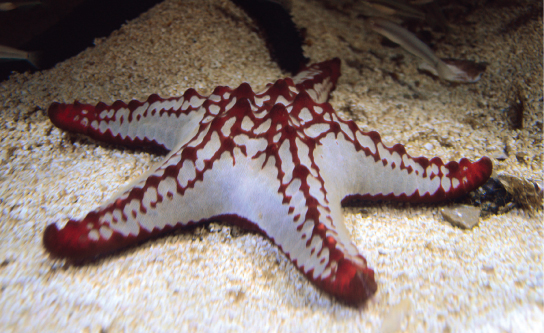
The skeleton of the red-knobbed ocean star (Protoreaster linckii) is an example of a hydrostatic skeleton. (credit: "Amada44"/Wikimedia Commons)
Motility in a hydrostatic skeleton is provided by muscles that environs the coelom. The muscles in a hydrostatic skeleton contract to change the shape of the coelom; the pressure of the fluid in the coelom produces motility. For example, earthworms motility past waves of muscular contractions of the skeletal muscle of the torso wall hydrostatic skeleton, chosen peristalsis, which alternately shorten and lengthen the body. Lengthening the body extends the anterior cease of the organism. Almost organisms take a machinery to fix themselves in the substrate. Shortening the muscles and then draws the posterior portion of the torso forward. Although a hydrostatic skeleton is well-suited to invertebrate organisms such every bit earthworms and some aquatic organisms, it is not an efficient skeleton for terrestrial animals.
Exoskeleton
An exoskeleton is an external skeleton that consists of a hard encasement on the surface of an organism. For example, the shells of crabs and insects are exoskeletons (Figure 19.3). This skeleton type provides defence against predators, supports the body, and allows for movement through the wrinkle of attached muscles. As with vertebrates, muscles must cross a joint inside the exoskeleton. Shortening of the muscle changes the relationship of the two segments of the exoskeleton. Arthropods such as crabs and lobsters have exoskeletons that consist of thirty–50 percent chitin, a polysaccharide derivative of glucose that is a strong but flexible cloth. Chitin is secreted by the epidermal cells. The exoskeleton is farther strengthened past the addition of calcium carbonate in organisms such as the lobster. Because the exoskeleton is acellular, arthropods must periodically shed their exoskeletons because the exoskeleton does not abound every bit the organism grows.
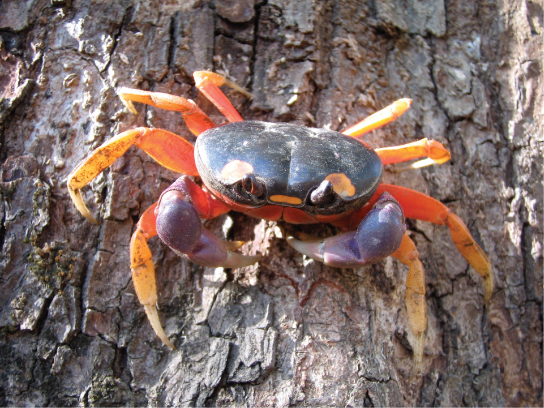
Muscles attached to the exoskeleton of the Halloween crab (Gecarcinus quadratus) allow it to move.
Endoskeleton
An endoskeleton is a skeleton that consists of hard, mineralized structures located within the soft tissue of organisms. An example of a primitive endoskeletal structure is the spicules of sponges. The bones of vertebrates are equanimous of tissues, whereas sponges have no truthful tissues (Figure 19.iv). Endoskeletons provide support for the torso, protect internal organs, and permit for movement through wrinkle of muscles attached to the skeleton.
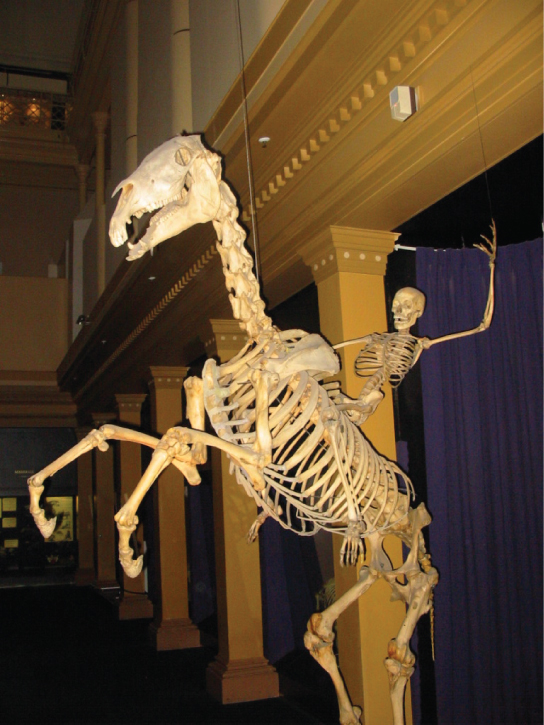
The skeletons of humans and horses are examples of endoskeletons. (credit: Ross Irish potato)
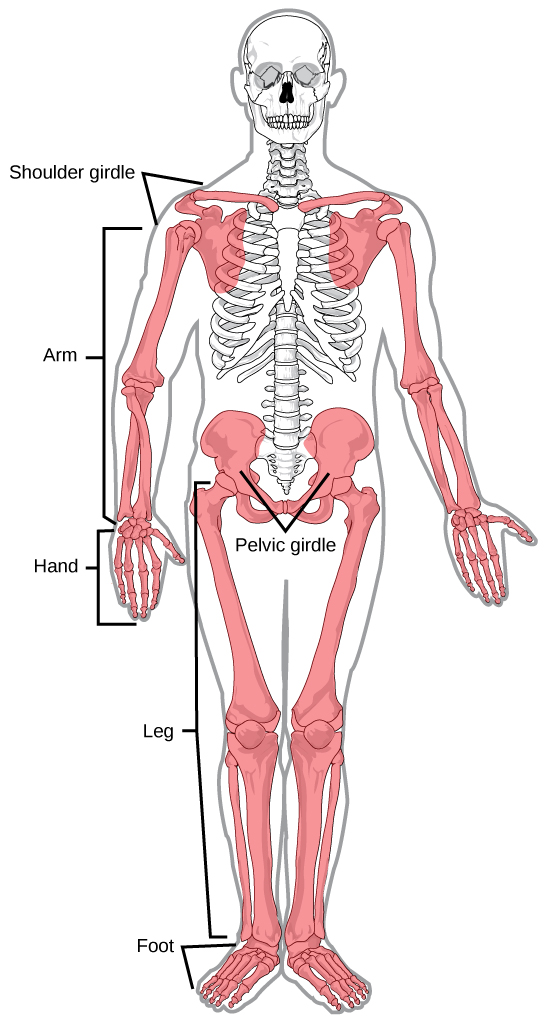
The human skeleton is an endoskeleton that consists of 206 bones in the adult. Information technology has 5 main functions: providing support to the trunk, storing minerals and lipids, producing blood cells, protecting internal organs, and allowing for movement. The skeletal organization in vertebrates is divided into the axial skeleton (which consists of the skull, vertebral column, and rib cage), and the appendicular skeleton (which consists of the shoulders, limb bones, the pectoral girdle, and the pelvic girdle).
Concept in Activity

Visit the interactive body site to build a virtual skeleton: select "skeleton" and click through the activity to identify each bone.
Human Axial Skeleton
The axial skeleton forms the central axis of the torso and includes the basic of the skull, ossicles of the eye ear, hyoid bone of the throat, vertebral column, and the thoracic muzzle (ribcage) (Figure 19.v). The office of the axial skeleton is to provide support and protection for the brain, the spinal string, and the organs in the ventral body crenel. Information technology provides a surface for the attachment of muscles that move the head, neck, and trunk, performs respiratory movements, and stabilizes parts of the appendicular skeleton.
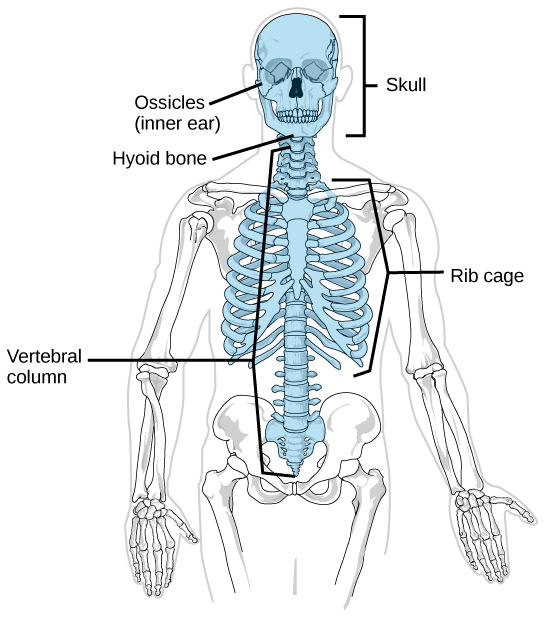
The axial skeleton consists of the bones of the skull, ossicles of the middle ear, hyoid bone, vertebral column, and rib cage. (credit: modification of piece of work by Mariana Ruiz Villareal)
The Skull
The bones of the skull support the structures of the face and protect the brain. The skull consists of 22 basic, which are divided into two categories: cranial bones and facial bones. The cranial basic are viii bones that form the cranial cavity, which encloses the brain and serves as an attachment site for the muscles of the head and neck. The viii cranial bones are the frontal bone, 2 parietal basic, two temporal bones, occipital bone, sphenoid os, and the ethmoid bone. Although the bones developed separately in the embryo and fetus, in the adult, they are tightly fused with connective tissue and adjoining bones do not movement (Effigy 19.vi).
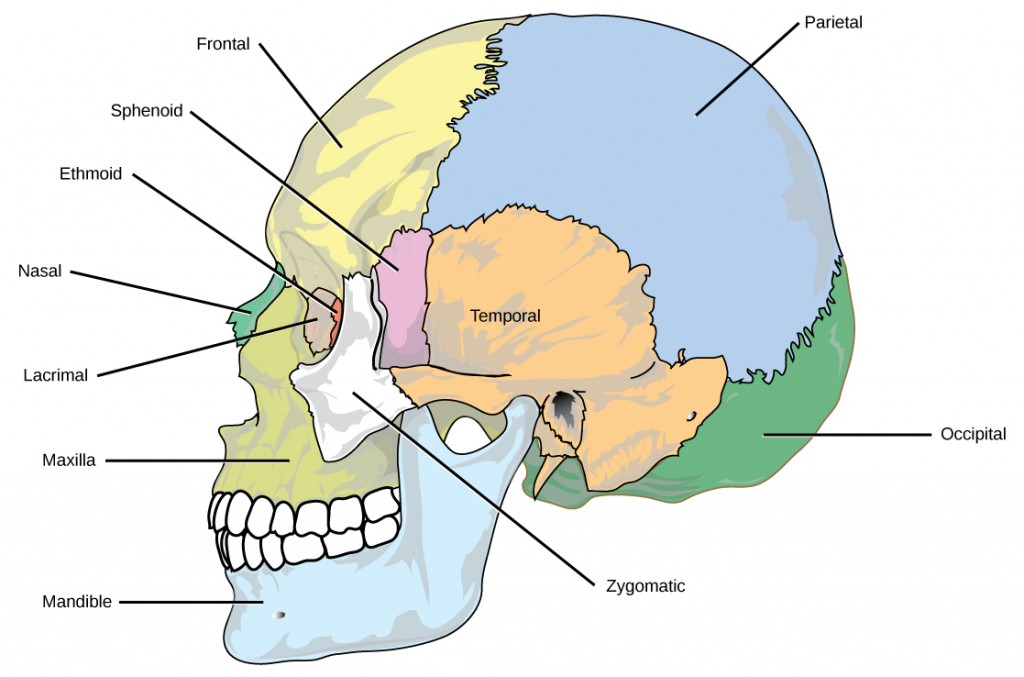
The basic of the skull support the structures of the confront and protect the brain. (credit: modification of piece of work by Mariana Ruiz Villareal)
The auditory ossicles of the centre ear transmit sounds from the air as vibrations to the fluid-filled cochlea. The auditory ossicles consist of six bones: ii malleus bones, two incus basic, and ii stapes on each side. These are the smallest bones in the body and are unique to mammals.
14 facial bones class the face up, provide cavities for the sense organs (eyes, mouth, and nose), protect the entrances to the digestive and respiratory tracts, and serve as zipper points for facial muscles. The 14 facial bones are the nasal bones, the maxillary bones, zygomatic bones, palatine, vomer, lacrimal bones, the junior nasal conchae, and the mandible. All of these bones occur in pairs except for the mandible and the vomer (Figure 19.vii).
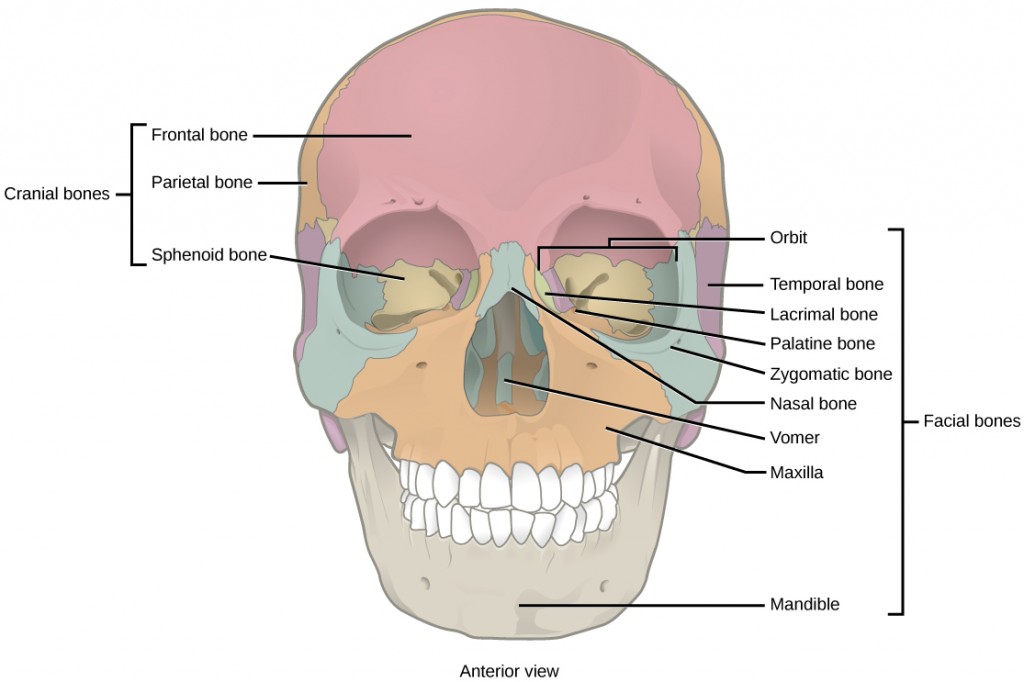
The cranial bones, including the frontal, parietal, and sphenoid bones, encompass the summit of the caput. The facial bones of the skull class the face and provide cavities for the eyes, nose, and mouth.
Although it is not establish in the skull, the hyoid bone is considered a component of the centric skeleton. The hyoid bone lies below the mandible in the front of the cervix. It acts equally a movable base for the natural language and is connected to muscles of the jaw, larynx, and tongue. The mandible articulates with the base of the skull. The mandible controls the opening to the airway and gut. In animals with teeth, the mandible brings the surfaces of the teeth in contact with the maxillary teeth.
The Vertebral Column
The vertebral column, or spinal column, surrounds and protects the spinal cord, supports the head, and acts as an attachment bespeak for the ribs and muscles of the back and neck. The adult vertebral column comprises 26 bones: the 24 vertebrae, the sacrum, and the coccyx basic. In the adult, the sacrum is typically composed of five vertebrae that fuse into i. The coccyx is typically three–4 vertebrae that fuse into ane. Around the age of 70, the sacrum and the coccyx may fuse together. We brainstorm life with approximately 33 vertebrae, but as we grow, several vertebrae fuse together. The adult vertebrae are further divided into the seven cervical vertebrae, 12 thoracic vertebrae, and 5 lumbar vertebrae (Figure 19.8).
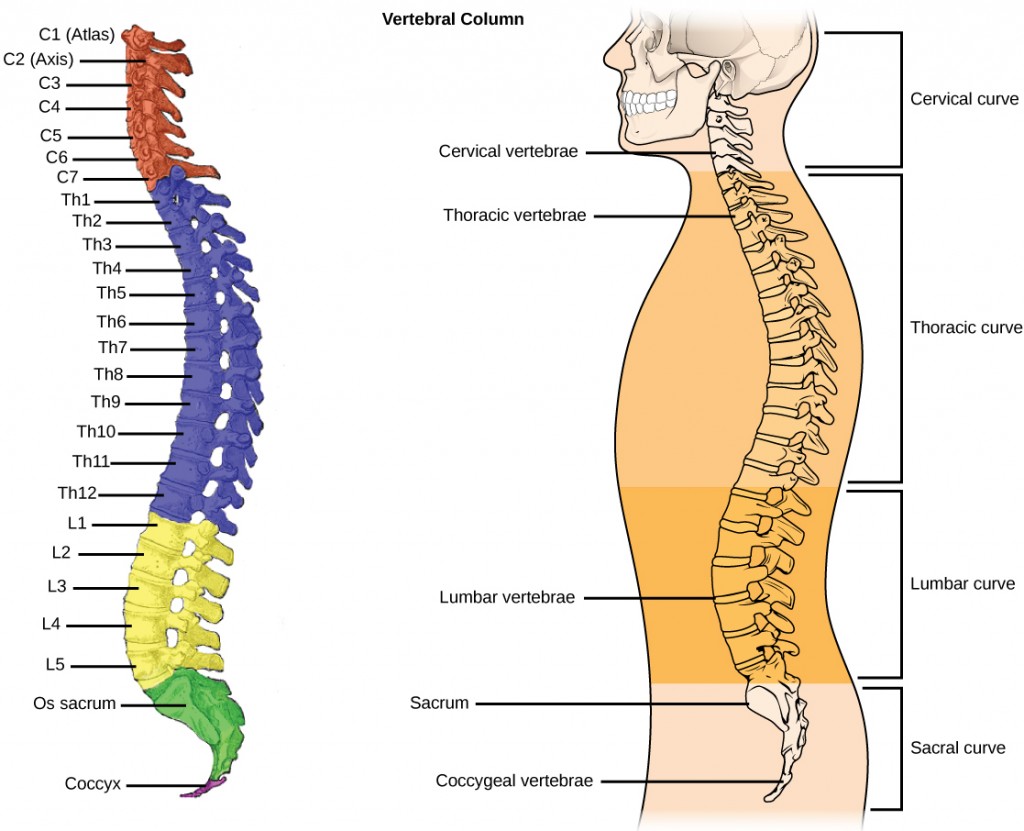
Each vertebral body has a large hole in the centre through which the nerves of the spinal cord laissez passer. There is also a notch on each side through which the spinal nerves, which serve the body at that level, can leave from the spinal cord. The vertebral column is approximately 71 cm (28 inches) in adult male humans and is curved, which can be seen from a side view. The names of the spinal curves represent to the region of the spine in which they occur. The thoracic and sacral curves are concave (curve inwards relative to the front end of the trunk) and the cervical and lumbar curves are convex (curve outwards relative to the front of the body). The arched curvature of the vertebral column increases its strength and flexibility, allowing it to blot shocks like a spring (Figure 19.viii).
Intervertebral discs composed of fibrous cartilage lie between adjacent vertebral bodies from the 2nd cervical vertebra to the sacrum. Each disc is part of a articulation that allows for some motion of the spine and acts as a cushion to blot shocks from movements such every bit walking and running. Intervertebral discs likewise human action as ligaments to bind vertebrae together. The inner office of discs, the nucleus pulposus, hardens as people age and becomes less elastic. This loss of elasticity diminishes its power to blot shocks.
The Thoracic Muzzle
The thoracic muzzle, also known as the ribcage, is the skeleton of the chest, and consists of the ribs, sternum, thoracic vertebrae, and costal cartilages (Figure 19.ix). The thoracic cage encloses and protects the organs of the thoracic cavity, including the heart and lungs. Information technology also provides back up for the shoulder girdles and upper limbs, and serves as the zipper point for the diaphragm, muscles of the back, breast, neck, and shoulders. Changes in the book of the thorax enable breathing.
The sternum, or breastbone, is a long, apartment bone located at the anterior of the breast. It is formed from 3 bones that fuse in the developed. The ribs are 12 pairs of long, curved bones that attach to the thoracic vertebrae and curve toward the front of the torso, forming the ribcage. Costal cartilages connect the anterior ends of the ribs to the sternum, with the exception of rib pairs xi and 12, which are free-floating ribs.
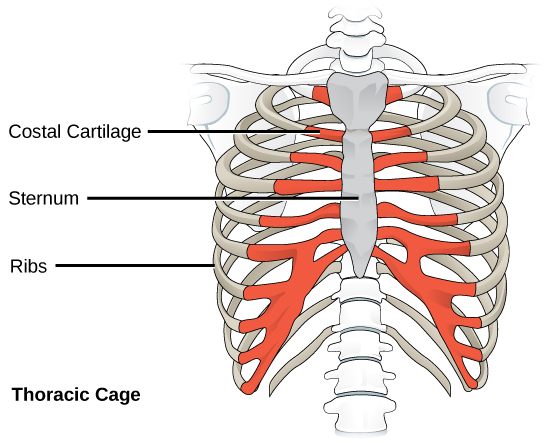
The thoracic cage, or rib muzzle, protects the heart and the lungs. (credit: modification of work by NCI, NIH)
Homo Appendicular Skeleton
The appendicular skeleton is composed of the bones of the upper limbs (which function to grasp and manipulate objects) and the lower limbs (which permit locomotion). It also includes the pectoral girdle, or shoulder girdle, that attaches the upper limbs to the body, and the pelvic girdle that attaches the lower limbs to the torso (Figure 19.10).
The Pectoral Girdle
The pectoral girdle basic provide the points of zipper of the upper limbs to the axial skeleton. The homo pectoral girdle consists of the clavicle (or collarbone) in the inductive, and the scapula (or shoulder blades) in the posterior (Figure nineteen.eleven).
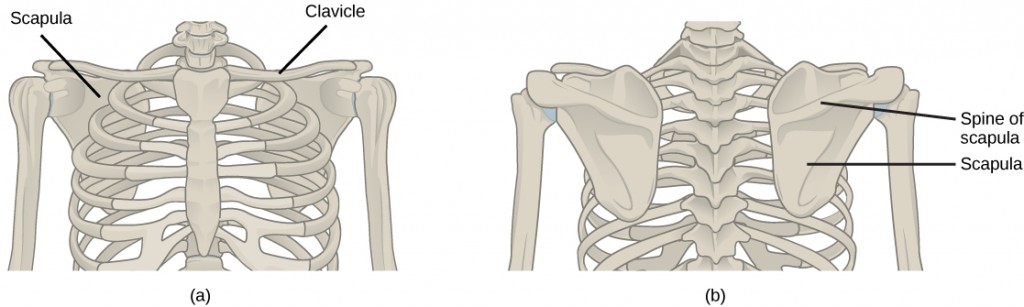
(a) The pectoral girdle in primates consists of the clavicles and scapulae. (b) The posterior view reveals the spine of the scapula to which musculus attaches.
The clavicles are S-shaped bones that position the arms on the body. The clavicles lie horizontally across the forepart of the thorax (chest) just above the starting time rib. These bones are fairly fragile and are susceptible to fractures. For case, a autumn with the arms outstretched causes the force to be transmitted to the clavicles, which tin suspension if the strength is excessive. The clavicle articulates with the sternum and the scapula.
The scapulae are apartment, triangular bones that are located at the back of the pectoral girdle. They back up the muscles crossing the shoulder joint. A ridge, called the spine, runs across the back of the scapula and can hands exist felt through the peel (Figure xix.11). The spine of the scapula is a expert example of a bony protrusion that facilitates a broad area of attachment for muscles to bone.
The Upper Limb
The upper limb contains 30 bones in three regions: the arm (shoulder to elbow), the forearm (ulna and radius), and the wrist and hand (Figure 19.12).
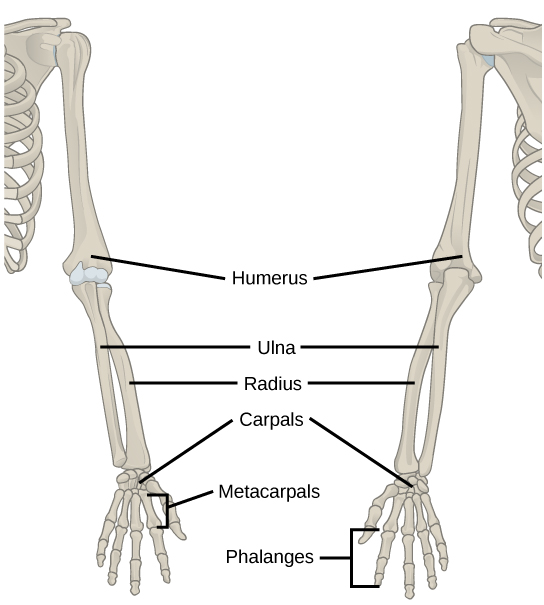
The upper limb consists of the humerus of the upper arm, the radius and ulna of the forearm, 8 basic of the carpus, v bones of the metacarpus, and 14 bones of the phalanges.
An joint is any identify at which two bones are joined. The humerus is the largest and longest bone of the upper limb and the only bone of the arm. Information technology articulates with the scapula at the shoulder and with the forearm at the elbow. The forearm extends from the elbow to the wrist and consists of two bones: the ulna and the radius. The radius is located along the lateral (thumb) side of the forearm and articulates with the humerus at the elbow. The ulna is located on the medial aspect (pinky-finger side) of the forearm. It is longer than the radius. The ulna articulates with the humerus at the elbow. The radius and ulna also clear with the carpal bones and with each other, which in vertebrates enables a variable caste of rotation of the carpus with respect to the long axis of the limb. The manus includes the eight basic of the carpus (wrist), the v bones of the metacarpus (palm), and the 14 bones of the phalanges (digits). Each digit consists of three phalanges, except for the pollex, when nowadays, which has only two.
The Pelvic Girdle
The pelvic girdle attaches to the lower limbs of the centric skeleton. Because information technology is responsible for bearing the weight of the body and for locomotion, the pelvic girdle is securely attached to the centric skeleton by potent ligaments. It also has deep sockets with robust ligaments to securely attach the femur to the torso. The pelvic girdle is further strengthened by two large hip bones. In adults, the hip bones, or coxal bones are formed by the fusion of 3 pairs of bones: the ilium, ischium, and pubis. The pelvis joins together in the anterior of the body at a articulation called the pubic symphysis and with the bones of the sacrum at the posterior of the torso.
The female pelvis is slightly different from the male pelvis. Over generations of evolution, females with a wider pubic angle and larger diameter pelvic canal reproduced more than successfully. Therefore, their offspring also had pelvic anatomy that enabled successful childbirth (Figure nineteen.13).
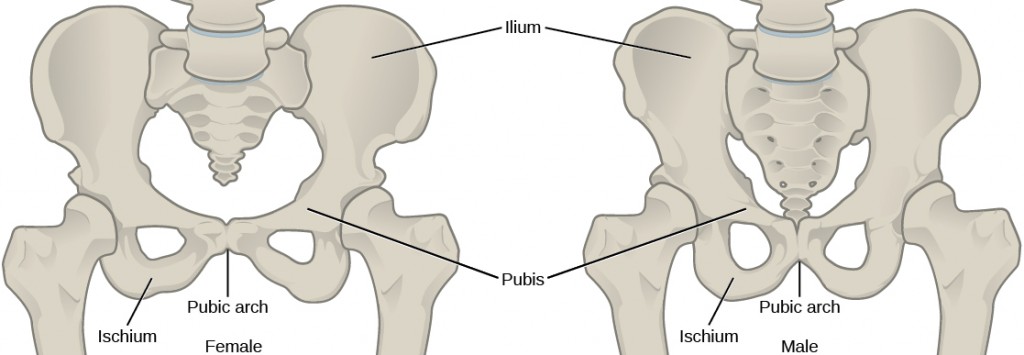
To adapt to reproductive fitness, the (a) female pelvis is lighter, wider, shallower, and has a broader angle betwixt the pubic bones than (b) the male pelvis.
The Lower Limb
The lower limb consists of the thigh, the leg, and the human foot. The bones of the lower limb are the femur (thigh bone), patella (kneecap), tibia and fibula (bones of the leg), tarsals (bones of the talocrural joint), and metatarsals and phalanges (bones of the foot) (Effigy 19.14). The basic of the lower limbs are thicker and stronger than the bones of the upper limbs considering of the need to support the entire weight of the body and the resulting forces from locomotion. In addition to evolutionary fitness, the basic of an individual will reply to forces exerted upon them.
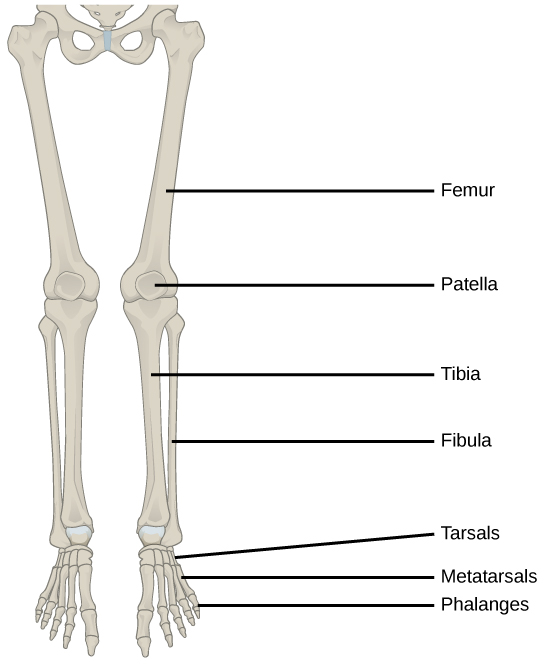
The lower limb consists of the thigh (femur), kneecap (patella), leg (tibia and fibula), ankle (tarsals), and foot (metatarsals and phalanges) basic.
The femur, or thighbone, is the longest, heaviest, and strongest bone in the trunk. The femur and pelvis form the hip joint at the proximal end. At the distal end, the femur, tibia, and patella course the knee joint. The patella, or kneecap, is a triangular bone that lies anterior to the knee joint. The patella is embedded in the tendon of the femoral extensors (quadriceps). It improves knee extension by reducing friction. The tibia, or shinbone, is a large bone of the leg that is located directly below the articulatio genus. The tibia articulates with the femur at its proximal finish, with the fibula and the tarsal bones at its distal end. It is the second largest bone in the human torso and is responsible for transmitting the weight of the body from the femur to the pes. The fibula, or calf bone, parallels and articulates with the tibia. It does not articulate with the femur and does not bear weight. The fibula acts as a site for muscle zipper and forms the lateral part of the ankle joint.
The tarsals are the seven bones of the ankle. The ankle transmits the weight of the body from the tibia and the fibula to the foot. The metatarsals are the five bones of the foot. The phalanges are the 14 bones of the toes. Each toe consists of three phalanges, except for the big toe that has only two (Figure 19.15). Variations exist in other species; for example, the horse's metacarpals and metatarsals are oriented vertically and do not make contact with the substrate.
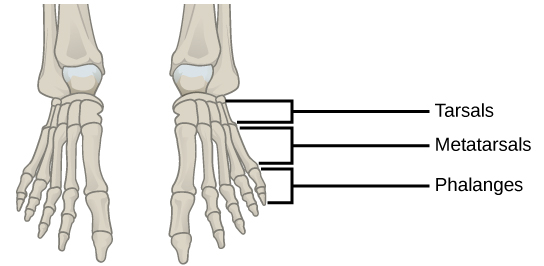
This drawing shows the bones of the man foot and ankle, including the metatarsals and the phalanges.
Evolution of Torso Design for Locomotion on Land
The transition of vertebrates onto land required a number of changes in torso blueprint, as motion on land presents a number of challenges for animals that are adapted to movement in water. The buoyancy of water provides a certain corporeality of elevator, and a mutual form of movement by fish is lateral undulations of the unabridged torso. This back and forth movement pushes the body against the water, creating forwards motility. In most fish, the muscles of paired fins attach to girdles within the body, allowing for some command of locomotion. Every bit certain fish began moving onto country, they retained their lateral undulation course of locomotion (anguilliform). All the same, instead of pushing against water, their fins or flippers became points of contact with the ground, around which they rotated their bodies.
The effect of gravity and the lack of buoyancy on country meant that body weight was suspended on the limbs, leading to increased strengthening and ossification of the limbs. The effect of gravity also required changes to the axial skeleton. Lateral undulations of land animate being vertebral columns cause torsional strain. A firmer, more ossified vertebral column became common in terrestrial tetrapods because it reduces strain while providing the force needed to back up the trunk's weight. In subsequently tetrapods, the vertebrae began allowing for vertical motility rather than lateral flexion. Another change in the centric skeleton was the loss of a straight attachment between the pectoral girdle and the head. This reduced the jarring to the caput caused by the affect of the limbs on the ground. The vertebrae of the neck also evolved to allow movement of the head independently of the trunk.
The appendicular skeleton of land animals is also different from aquatic animals. The shoulders attach to the pectoral girdle through muscles and connective tissue, thus reducing the jarring of the skull. Because of a lateral undulating vertebral column, in early on tetrapods, the limbs were splayed out to the side and movement occurred by performing "push-ups." The vertebrae of these animals had to motility side-to-side in a similar way to fish and reptiles. This type of motion requires big muscles to move the limbs toward the midline; information technology was nearly like walking while doing push-ups, and it is not an efficient use of energy. Later tetrapods accept their limbs placed under their bodies, then that each stride requires less force to move forwards. This resulted in decreased adductor muscle size and an increased range of motility of the scapulae. This likewise restricts movement primarily to one plane, creating forward movement rather than moving the limbs up besides as forrad. The femur and humerus were likewise rotated, and so that the ends of the limbs and digits were pointed forward, in the direction of motion, rather than out to the side. Past placement underneath the trunk, limbs tin swing frontward similar a pendulum to produce a stride that is more than efficient for moving over land.
Summary
The three types of skeleton designs are hydrostatic skeletons, exoskeletons, and endoskeletons. A hydrostatic skeleton is formed by a fluid-filled compartment held under hydrostatic force per unit area; motility is created past the muscles producing force per unit area on the fluid. An exoskeleton is a hard external skeleton that protects the outer surface of an organism and enables movement through muscles fastened on the inside. An endoskeleton is an internal skeleton composed of difficult, mineralized tissue that also enables motility past attachment to muscles. The human skeleton is an endoskeleton that is composed of the axial and appendicular skeleton. The centric skeleton is equanimous of the bones of the skull, ossicles of the ear, hyoid bone, vertebral cavalcade, and ribcage. The skull consists of eight cranial bones and 14 facial bones. Six bones make upward the ossicles of the eye ear, while the hyoid bone is located in the neck nether the mandible. The vertebral cavalcade contains 26 bones, and it surrounds and protects the spinal cord. The thoracic cage consists of the sternum, ribs, thoracic vertebrae, and costal cartilages. The appendicular skeleton is made up of the limbs of the upper and lower limbs. The pectoral girdle is composed of the clavicles and the scapulae. The upper limb contains 30 bones in the arm, the forearm, and the hand. The pelvic girdle attaches the lower limbs to the axial skeleton. The lower limb includes the basic of the thigh, the leg, and the pes.
Exercises
- Which of the post-obit statements about bone tissue is false?
- Compact bone tissue is made of cylindrical osteons that are aligned such that they travel the length of the bone.
- Haversian canals comprise blood vessels only.
- Haversian canals contain blood vessels and nerve fibers.
- Spongy tissue is institute on the interior of the bone, and compact bone tissue is found on the exterior.
- The forearm consists of the:
- radius and ulna
- radius and humerus
- ulna and humerous
- humerus and carpus
- The pectoral girdle consists of the:
- clavicle and sternum
- sternum and scapula
- clavicle and scapula
- clavicle and coccyx
- All of the following are groups of vertebrae except ________, which is a curvature.
- thoracic
- cervical
- lumbar
- pelvic
- Which of these is a facial bone?
- frontal
- occipital
- lacrimal
- temporal
- What are the major differences between the male pelvis and female pelvis that let childbirth in females?
- What are the major differences between the pelvic girdle and the pectoral girdle that allow the pelvic girdle to bear the weight of the torso?
Answers
- B
- A
- C
- D
- C
- The female person pelvis is tilted forward and is wider, lighter, and shallower than the male person pelvis. It is also has a pubic bending that is broader than the male pelvis.
- The pelvic girdle is securely attached to the torso past strong ligaments, unlike the pectoral girdle, which is sparingly attached to the ribcage. The sockets of the pelvic girdle are deep, allowing the femur to be more stable than the pectoral girdle, which has shallow sockets for the scapula. Most tetrapods have 75 percent of their weight on the front end legs because the head and cervix are so heavy; the advantage of the shoulder articulation is more degrees of freedom in movement.
Glossary
- abduction
- when a bone moves abroad from the midline of the trunk
- actin
- globular contractile poly peptide that interacts with myosin for muscle contraction
- appendicular skeleton
- equanimous of the basic of the upper limbs, which function to grasp and manipulate objects, and the lower limbs, which let locomotion
- articulation
- any place where two bones are joined
- auditory ossicle
- (besides, middle ear) transduces sounds from the air into vibrations in the fluid-filled cochlea
- axial skeleton
- forms the primal axis of the body and includes the bones of the skull, the ossicles of the eye ear, the hyoid bone of the throat, the vertebral cavalcade, and the thoracic cage (ribcage)
- bone remodeling
- replacement of old os tissue by new bone tissue
- os
- (besides, osseous tissue) connective tissue that constitutes the endoskeleton
- carpus
- viii bones that comprise the wrist
- clavicle
- Due south-shaped bone that positions the arms laterally
- compact bone
- forms the hard external layer of all bones
- coxal os
- hip bone
- cranial bone
- ane of eight bones that form the cranial crenel that encloses the brain and serves as an attachment site for the muscles of the head and neck
- diaphysis
- primal shaft of bone, contains os marrow in a marrow cavity
- endoskeleton
- skeleton of living cells that produce a hard, mineralized tissue located within the soft tissue of organisms
- epiphyseal plate
- region betwixt the diaphysis and epiphysis that is responsible for the lengthwise growth of long basic
- epiphysis
- rounded terminate of bone, covered with articular cartilage and filled with red bone marrow, which produces blood cells
- exoskeleton
- a secreted cellular product external skeleton that consists of a difficult encasement on the surface of an organism
- extension
- movement in which the bending between the basic of a joint increases; reverse of flexion
- facial bone
- one of the fourteen bones that class the face; provides cavities for the sense organs (optics, oral cavity, and nose) and attachment points for facial muscles
- femur
- (too, thighbone) longest, heaviest, and strongest bone in the body
- fibula
- (likewise, calf bone) parallels and articulates with the tibia
- flat bone
- thin and relatively wide os plant where all-encompassing protection of organs is required or where broad surfaces of muscle attachment are required
- flexion
- movement in which the bending betwixt the basic decreases; opposite of extension
- forearm
- extends from the elbow to the wrist and consists of two basic: the ulna and the radius
- Haversian canal
- contains the bone's blood vessels and nerve fibers
- humerus
- only bone of the arm
- hydrostatic skeleton
- skeleton that consists of aqueous fluid held under pressure level in a closed body compartment
- hyoid bone
- lies below the mandible in the front end of the neck
- joint
- point at which two or more bones meet
- lamella
- layer of compact tissue that surrounds a central culvert called the Haversian culvert
- long os
- os that is longer than wide, and has a shaft and 2 ends
- lower limb
- consists of the thigh, the leg, and the foot
- metacarpus
- 5 basic that comprise the palm
- metatarsal
- one of the v bones of the pes
- myofibril
- long cylindrical structures that lie parallel to the muscle fiber
- myosin
- contractile protein that interacts with actin for muscle contraction
- osseous tissue
- connective tissue that constitutes the endoskeleton
- ossification
- (besides, osteogenesis) procedure of bone formation by osteoblasts
- osteoblast
- bone cell responsible for bone formation
- osteoclast
- large bone cells with up to 50 nuclei, responsible for bone remodeling
- osteon
- cylindrical structure aligned parallel to the long centrality of the bone
- patella
- (also, kneecap) triangular bone that lies anterior to the knee articulation
- pectoral girdle
- bones that transmit the force generated by the upper limbs to the axial skeleton
- pelvic girdle
- bones that transmit the forcefulness generated by the lower limbs to the axial skeleton
- phalange
- one of the bones of the fingers or toes
- protraction
- anterior movement of a os in the horizontal plane
- radius
- os located along the lateral (thumb) side of the forearm; articulates with the humerus at the elbow
- rib
- ane of 12 pairs of long, curved bones that attach to the thoracic vertebrae and bend toward the front of the body to class the ribcage
- scapula
- flat, triangular bone located at the posterior pectoral girdle
- skull
- bone that supports the structures of the face and protects the brain
- sternum
- (also, breastbone) long, flat bone located at the front of the chest
- suture
- short cobweb of connective tissue that holds the skull bones tightly in place; constitute only in the skull
- symphysis
- hyaline cartilage covers the terminate of the bone, only the connection between basic occurs through fibrocartilage; symphyses are establish at the joints between vertebrae
- tarsal
- one of the seven bones of the ankle
- thoracic cage
- (likewise, ribcage) skeleton of the breast, which consists of the ribs, thoracic vertebrae, sternum, and costal cartilages
- tibia
- (also, shinbone) large bone of the leg that is located directly beneath the knee
- tropomyosin
- acts to block myosin binding sites on actin molecules, preventing cross-bridge germination and preventing wrinkle until a muscle receives a neuron betoken
- ulna
- bone located on the medial aspect (pinky-finger side) of the forearm
- vertebral column
- (also, spine) surrounds and protects the spinal cord, supports the head, and acts as an zipper point for ribs and muscles of the back and cervix
Source: https://opentextbc.ca/biology/chapter/19-1-types-of-skeletal-systems/
Posted by: shirkgrany1969.blogspot.com
0 Response to "What Part Of The Skull Reveals The Most About An Animal's Lifestyle"
Post a Comment