

Are Humans The Only Animal Whose Major Predator Is Themselves
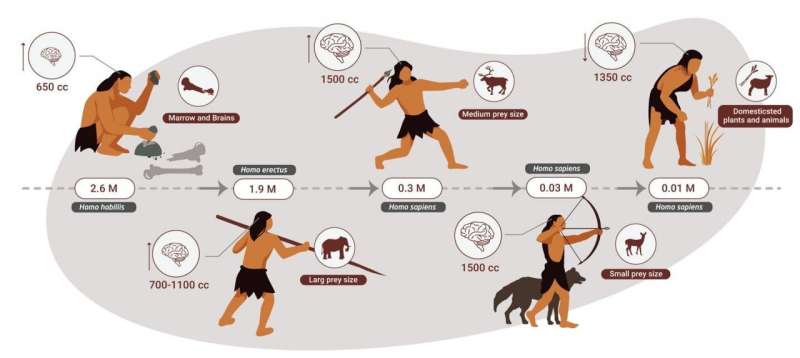
Researchers at Tel Aviv Academy were able to reconstruct the nutrition of rock age humans. In a paper published in the Yearbook of the American Physical Anthropology Association, Dr. Miki Ben-Dor and Prof. Ran Barkai of the Jacob M. Alkov Department of Archaeology at Tel Aviv Academy, together with Raphael Sirtoli of Portugal, show that humans were an apex predator for about two one thousand thousand years. Only the extinction of larger animals (megafauna) in diverse parts of the world, and the pass up of animal food sources toward the cease of the stone age, led humans to gradually increase the vegetable chemical element in their diet, until finally they had no pick just to domesticate both plants and animals—and became farmers.
"And then far, attempts to reconstruct the diet of stone-historic period humans were mostly based on comparisons to 20th century hunter-gatherer societies," explains Dr. Ben-Dor. "This comparison is futile, yet, because 2 million years ago hunter-gatherer societies could hunt and consume elephants and other big animals—while today'due south hunter gatherers do not have admission to such bounty. The entire ecosystem has changed, and conditions cannot exist compared. We decided to use other methods to reconstruct the nutrition of stone-age humans: to examine the memory preserved in our own bodies, our metabolism, genetics and concrete build. Human behavior changes rapidly, only development is boring. The trunk remembers."
In a process unprecedented in its extent, Dr. Ben-Dor and his colleagues nerveless about 25 lines of show from about 400 scientific papers from different scientific disciplines, dealing with the focal question: Were stone-historic period humans specialized carnivores or were they generalist omnivores? Most evidence was found in research on current biological science, namely genetics, metabolism, physiology and morphology.
"1 prominent example is the acerbity of the human being tummy," says Dr. Ben-Dor. "The acerbity in our tummy is high when compared to omnivores and fifty-fifty to other predators. Producing and maintaining strong acidity crave big amounts of energy, and its existence is evidence for consuming animal products. Strong acidity provides protection from harmful bacteria found in meat, and prehistoric humans, hunting large animals whose meat sufficed for days or fifty-fifty weeks, often consumed old meat containing big quantities of bacteria, and thus needed to maintain a high level of acidity. Another indication of being predators is the structure of the fat cells in our bodies. In the bodies of omnivores, fat is stored in a relatively small number of large fat cells, while in predators, including humans, it's the other way around: nosotros have a much larger number of smaller fat cells. Significant evidence for the development of humans equally predators has also been found in our genome. For example, geneticists accept ended that "areas of the homo genome were closed off to enable a fatty-rich nutrition, while in chimpanzees, areas of the genome were opened to enable a sugar-rich diet."
Bear witness from human biological science was supplemented by archaeological evidence. For instance, research on stable isotopes in the bones of prehistoric humans, also equally hunting practices unique to humans, show that humans specialized in hunting large and medium-sized animals with high fat content. Comparing humans to big social predators of today, all of whom hunt large animals and obtain more than than 70% of their energy from beast sources, reinforced the conclusion that humans specialized in hunting large animals and were in fact hypercarnivores.
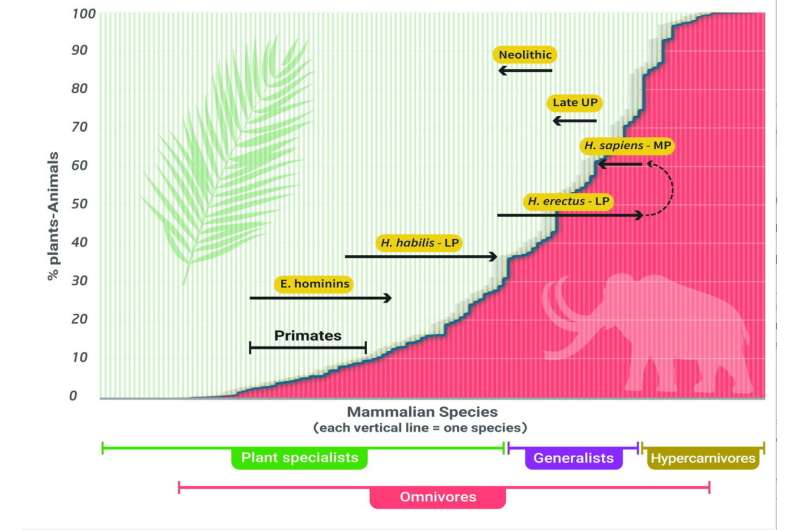
"Hunting big animals is non an afternoon hobby," says Dr. Ben-Dor. "It requires a great deal of knowledge, and lions and hyenas reach these abilities after long years of learning. Clearly, the remains of big animals found in countless archaeological sites are the effect of humans' loftier expertise every bit hunters of large animals. Many researchers who study the extinction of the large animals agree that hunting by humans played a major role in this extinction—and there is no better proof of humans' specialization in hunting large animals. Most probably, like in current-solar day predators, hunting itself was a focal homo activity throughout virtually of human being evolution. Other archaeological evidence—like the fact that specialized tools for obtaining and processing vegetable foods only appeared in the subsequently stages of human being development—also supports the centrality of large animals in the human diet, throughout near of human history."
The multidisciplinary reconstruction conducted past TAU researchers for almost a decade proposes a complete change of paradigm in the agreement of homo evolution. Reverse to the widespread hypothesis that humans owe their evolution and survival to their dietary flexibility, which allowed them to combine the hunting of animals with vegetable foods, the motion-picture show emerging hither is of humans evolving mostly as predators of large animals.
"Archaeological evidence does not overlook the fact that stone-age humans also consumed plants," adds Dr. Ben-Dor. "But co-ordinate to the findings of this study plants only became a major component of the homo diet toward the end of the era."
Evidence of genetic changes and the appearance of unique stone tools for processing plants led the researchers to conclude that, starting nigh 85,000 years ago in Africa, and near 40,000 years ago in Europe and Asia, a gradual rise occurred in the consumption of plant foods as well as dietary diverseness—in accordance with varying ecological conditions. This rise was accompanied by an increase in the local uniqueness of the stone tool culture, which is like to the diversity of fabric cultures in 20th-century hunter-gatherer societies. In contrast, during the 2 one thousand thousand years when, co-ordinate to the researchers, humans were apex predators, long periods of similarity and continuity were observed in stone tools, regardless of local ecological conditions.
"Our study addresses a very great current controversy—both scientific and non-scientific," says Prof. Barkai. "For many people today, the Paleolithic diet is a critical issue, non only with regard to the past, merely likewise apropos the present and hereafter. It is hard to convince a devout vegetarian that his/her ancestors were non vegetarians, and people tend to confuse personal beliefs with scientific reality. Our study is both multidisciplinary and interdisciplinary. We propose a flick that is unprecedented in its inclusiveness and breadth, which clearly shows that humans were initially noon predators, who specialized in hunting big animals. As Darwin discovered, the adaptation of species to obtaining and digesting their food is the master source of evolutionary changes, and thus the claim that humans were apex predators throughout most of their development may provide a broad basis for fundamental insights on the biological and cultural development of humans."
More information: Miki Ben‐Dor et al, The evolution of the human trophic level during the Pleistocene, American Periodical of Physical Anthropology (2021). DOI: ten.1002/ajpa.24247
Citation: Humans were apex predators for two 1000000 years (2021, April 5) retrieved 26 June 2022 from https://phys.org/news/2021-04-humans-apex-predators-meg-years.html
This document is subject area to copyright. Apart from whatever fair dealing for the purpose of private study or research, no function may be reproduced without the written permission. The content is provided for information purposes only.
Source: https://phys.org/news/2021-04-humans-apex-predators-million-years.html
Posted by: shirkgrany1969.blogspot.com
0 Response to "Are Humans The Only Animal Whose Major Predator Is Themselves"
Post a Comment