

Is The Hippo The Most Dangerous Animal

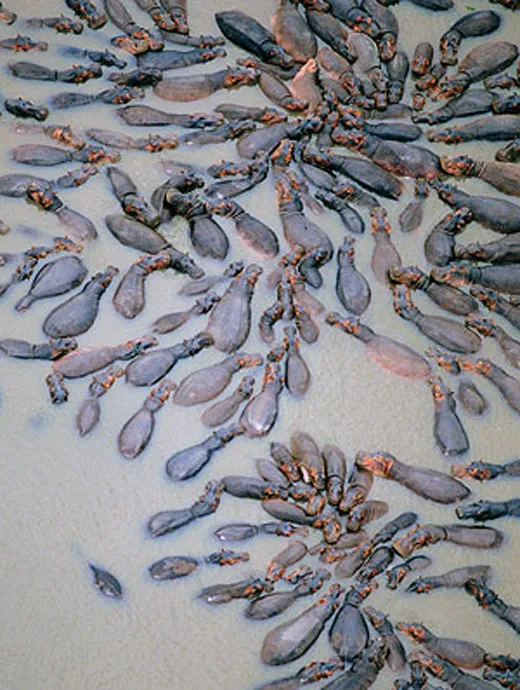
Nosotros hear the hippos before we see them, grunting, wheezing, honking and emitting a characteristic laugh-like audio, a booming humph humph humph that shakes the leaves. Turning a corner nosotros run into the pod, 23 strong, nearly submerged in the muddy stream.
The dominant bull, all half dozen,000 pounds of him, swings effectually to face us. Hippos have poor eyesight simply an excellent sense of smell, and he's caught our olfactory property. Karen Paolillo, an Englishwoman who has spent 15 years protecting this grouping of hippos in Zimbabwe, calls out to ease the animals' alarm: "Hello, Robin. Hi, Surprise. Hullo, Tempest."
She is most worried nigh Greasepaint, a cantankerous female guarding an 8- month-onetime calf that is nuzzled against her at the edge of the huddle. Blackface bares her enormous teeth, and Paolillo tenses. "She hates people, and she'southward charged me plenty of times," she says in a soft vocalism. "If she charges, you won't go much alarm, so get up the nearest tree as fast as you tin."
Paolillo, fifty, lives on a wild animals conservancy 280 miles southeast of Harare, Republic of zimbabwe's uppercase. At one million acres, the Savé Valley Conservancy is Africa'south largest private wild fauna park. But it's no refuge from the political anarchy that has gripped Republic of zimbabwe for the by v years. Allies of Zimbabwe's president, Robert Mugabe, have taken over 36,000 acres near where Karen and her hubby, Jean-Roger Paolillo, alive and threatened to burn their firm down. And Jean has been charged with murder.
Karen, who is off-white-haired and frail, came by her honey of animals naturally: she was built-in on the outskirts of London to a veterinary father and a mother who ran a children's zoo. In 1975, she abandoned a career in journalism to railroad train as a casino croupier, a trade that would allow her to travel the earth. In Zimbabwe, she became a safari guide. She married Jean, a French geologist, in 1988, and joined him when he took a chore with a mining company searching for gold. They found none. Only when Karen learned that poachers were killing hippos near their base of operations army camp, she vowed to help the animals. She and Jean leased eight acres in Savé Valley, where they lookout over the concluding of the Turgwe River's 23 hippos. She knows each hippo's temperament, social status, family history and grudges.
Robin, the ascendant male person, edges toward Blackface and her calf, which Karen calls "5." The big female person lunges at him, sending plumes of water into the air and chasing him away. "Blackface is a very good mother and takes special intendance of her calves," Paolillo says.
On the other side of the stream, Tacha, a immature female, edges toward Tempest, an 8-year-sometime male that Robin tolerates as long as he remains subservient. Tacha dips her face in front of Storm and begins to blow bubbles through the h2o, a hippo flirtation. "She'south signaling to Tempest that she wants to mate with him," whispers Paolillo. "It could mean trouble, because that's Robin'southward privilege."
Storm faces Tacha and lowers his mouth into the water, letting Tacha know that he welcomes her advances. But Blackface maneuvers her ain trunk between the immature lovers and pushes Tempest, who happens to be her grandson, to the back of the huddle. "She's protecting him from Robin's anger considering he'd attack Storm and could kill him if he tried to mate with Tacha," Paolillo says. As if to assert his dominance, Robin immediately mounts Tacha and mates with her.
To many, the hippo is a comical creature. In the Walt Disney cartoon Fantasia, a troupe of hippo ballerinas in tiny tutus performs gravity-defying classical dance with lecherous male alligators. Simply many Africans regard hippos equally the continent's nigh unsafe animal. Although authentic numbers are difficult to come by, lore has it that hippos kill more than people each year than lions, elephants, leopards, buffaloes and rhinos combined.
Hippo pods are led by dominant males, which tin can weigh 6,000 pounds or more. Females and nearly other males weigh between 3,500 and four,500 pounds, and all live about 40 years. Available males graze solitary, non stiff enough to defend a harem, which tin can include as many equally xx females. A hippopotamus (the Greek word means "river equus caballus") spends most of the 24-hour interval in the h2o dozing. At night hippos emerge and eat from 50 to 100 pounds of vegetation. Hippos tin can exist testy and roughshod when information technology comes to defending their territory and their immature. Though they occasionally spar with crocodiles, a growing number of skirmishes are with humans. Hippos have trampled or gored people who strayed also almost, dragged them into lakes, tipped over their boats, and bitten off their heads.
Because hippos live in fresh water, they are "in the cantankerous hairs of conflict," says biologist Rebecca Lewison, caput of the World Conservation Marriage's hippo inquiry group. "Fresh h2o is probably the well-nigh valuable and limited resource in Africa." Agricultural irrigation systems and other development have depleted hippos'—and other animals'—wetland, river and lake habitats. And the expansion of waterside farms, which hippos oftentimes raid, has increased the risk that the animals will tangle with people.
In countries beset by civil unrest, where people are hungry and desperate, hippos are poached for their meat; i hippo yields about a ton of it. Some are killed for their tusk-like teeth, which can grow up to a foot or longer. (Though smaller than elephant tusks, hippo tusks don't yellowish with historic period. One of George Washington's sets of false teeth was carved from hippo ivory.)
Hippos in one case roamed over most of Africa except the Sahara. Today they can be plant in 29 African countries. (The extremely rare pygmy hippopotamus, a related species, is found in only a few West African forests.) A decade agone at that place were about 160,000 hippos in Africa, merely the population has dwindled to between 125,000 and 148,000 today, according to the Globe Conservation Spousal relationship. The United nations is about to list the hippopotamus every bit a "vulnerable" species.
The about dramatic losses accept been reported in the Autonomous Commonwealth of Congo (DRC), where ceremonious war and militia rampages, with subsequent disease and starvation, accept killed an estimated 3 one thousand thousand people in the past decade. Hippos are reportedly existence killed by local militia, poachers, government soldiers and Hutu refugees who fled neighboring Rwanda after participating in the 1994 genocide of Tutsis. In 1974, it was estimated that about 29,000 hippos lived in DRC'south Virunga National Park. An aerial survey conducted this past August past the Congolese Institute for the Conservation of Nature found just 887 remaining.
The hippo has long fascinated me as one of nature's about misunderstood, even paradoxical, creatures: a terrestrial mammal that spends nigh of its fourth dimension in water, a two-ton mass that can sprint faster than a person, a seemingly placid oaf that guards its family with fierce cunning. So I went to Republic of kenya, where a stable regime has taken pains to protect the animal, to meet large numbers of hippos up close. I went to Zimbabwe, in dissimilarity, to become a feel for the bear on of civil strife on this extraordinary animal.
Because Zimbabwe rarely grants visas to foreign journalists, I traveled there equally a tourist and did my reporting without government permission. I entered through Bulawayo, a southern city in the homeland of the Ndebele tribe. The Ndebele people are traditional rivals of the Shona, Mugabe's tribe. Almost street life in Africa is bouncy, but the streets of Bulawayo are subdued, the effect of Mugabe'south recent crackdown. People walk with heads downward, every bit if trying not to attract attention. At gas stations cars line up for fuel, sometimes for weeks.
Zimbabwe is in trouble. It suffers seventy percentage unemployment, mass poverty, annual inflation as loftier equally 600 percent and widespread hunger. Over the past ten years, life expectancy has dropped from 63 to 39 years of age, largely due to AIDS (one quarter of the population is infected with HIV) and malnutrition. Mugabe, a Marxist, has ruled the state since information technology gained independence from Britain in 1980, post-obit 20 years of guerrilla war to overthrow Ian Smith's white-led government of what was then called Rhodesia. According to Amnesty International, Mugabe has rigged elections to stay in ability, and he has jailed, tortured and murdered opponents. Since March 2005, when Mugabe and his ZANU-PF political party won a national ballot described past Amnesty International as taking identify in a "climate of intimidation and harassment," conditions have deteriorated markedly in those parts of the land that voted for Mugabe'southward opponents. His "Youth Brigades"—young thugs outfitted as paramilitary groups—have destroyed streetmarkets and bulldozed squatter camps in a entrada Mugabe named Functioning Murambatsvina, a Shona term significant "drive out the rubbish." AU.N. report estimates that the campaign has left 700,000 of the country's 13 million people jobless, homeless or both.
In 2000, Zimbabwe was Africa's second most robust economy after South Africa, simply then Mugabe began appropriating farmland and giving it to friends and veterans of the 1970s guerrilla wars. Most of the new landowners—including the justice minister, Patrick Chinamasa, who grabbed two farms—had no experience in big-calibration farming, and and then most farms have fallen fallow or are used for subsistence living.
At the Savé Valley Salvation, originally formed in 1991 as a sanctuary for black rhinos, people belonging to the clan of a veteran named Robert Mamungaere are squatting on undeveloped country in and around the conservancy. They take cleared forests and built huts and fences. They've started killing wild fauna. And they mean business.
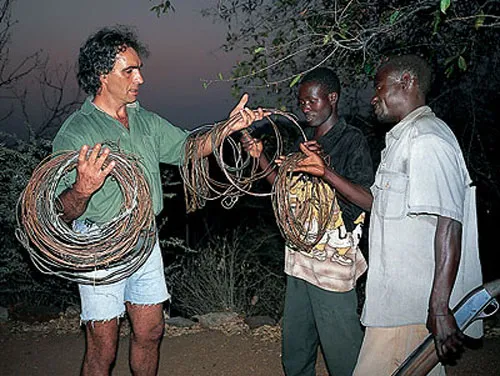
Jean-Roger Paolillo tries to keep the poachers away from the hippos. "I patrol our land every twenty-four hours, removing any snares I find and shooting the poachers' hunting dogs if I see them. I detest doing that, merely I accept to protect the wild animals. The invaders have retaliated by cutting our phone lines iv times and twice surrounding our house and threatening to burn it down."
The Paolillos faced their nigh severe crunch in Feb 2005, when a group of Youth Brigades and two uniformed policemen appeared exterior their door one forenoon. Shouting that Jean had killed someone, they marched him to the river. The dead man was a poacher, Jean says. "He had gone into a hippo tunnel in the reeds, and his companions said all they found of him were scraps of his clothing, blood smears and drag marks leading to the water."
Karen speculates that the poacher must have encountered a hippo called Cheeky, who was in the reeds with a newborn: "We think Derisive killed the poacher when he stumbled on her and the dogie, and then a crocodile found the body and dragged information technology into the water for a repast," she says.
The policemen arrested and handcuffed Jean and said they were taking him to the law station, an 8-hour expedition through the forest. They released him, but the charge still stands while the law investigate. He says that a mob led by a veteran guerrilla commander came to his house after the arrest and told Jean that unless he left immediately he would disappear in the bush.
Karen bristles at the retelling. "I reject to leave the hippos," she says.
They call the place Hippo Oasis, and that pretty much sums up the Paolillos' approach. They aren't bookish scientists. They haven't published whatsoever articles in learned journals, and they don't claim to be in the forefront of hippo ethology. They're zealots, actually, in a good sense of the word: they've thrown themselves wholeheartedly into this unlikely mission to protect a handful of vulnerable animals. Even though they might be better trained in blackjack and geology than in mammalian biology, they've spent and so many hours with these under-studied giants that they do possess unusual hippopotamus know-how.
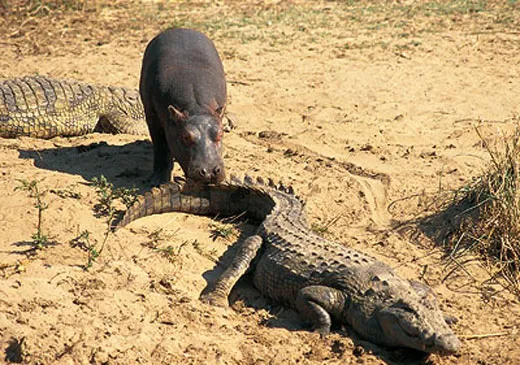
Watching these hippos for so many years, Karen has observed some odd behaviors. She shows me a video of hippos grooming big crocodiles, licking the crocs' skin near the base of their tails. "I think they're getting mineral salt from the pare of the crocodiles," Karen suggests. She has besides seen hippos tugging the prey of crocodiles, such every bit goats, from the reptiles' mouths, as if to rescue them.
Hippos announced to sweat blood. Paolillo has observed the phenomenon, maxim they sometimes secrete a slimy pink substance all over their bodies, especially when they are stressed. In 2004, researchers at KeioUniversity in Nihon analyzed a pigment in the hippo secretion and concluded that it may cake sunlight and act equally an antibiotic, hinting that the ooze might help skin injuries heal.
Like many people who take charge of wild animals, Karen has her favorites. Bob, the pod's dominant male when Karen arrived, learned to come when she called him. "He'due south the just hippo who ever did this for me," she says. So she was astonished one day when it seemed that Bob was charging her. She was certain she would be trampled—then realized that Bob was heading for a nine-foot crocodile that was behind her and poised to grab her. "Bob chased the crocodile abroad," she says.
Ii years ago in Feb a hunting-camp guard told her that Bob was dead in the river. "My starting time fear was that a poacher had shot him, simply and then I noticed a gaping hole under his jaw from a fight with some other bull. He had been gored and bled to death," Karen remembers. "I cried [because I was] then glad that he had died every bit a balderdash hippo, in a fight over females, and non by a bullet."
Source: https://www.smithsonianmag.com/science-nature/hippo-haven-107453678/
Posted by: shirkgrany1969.blogspot.com
0 Response to "Is The Hippo The Most Dangerous Animal"
Post a Comment